Titan Life? NASA's Discovery Changes Everything!
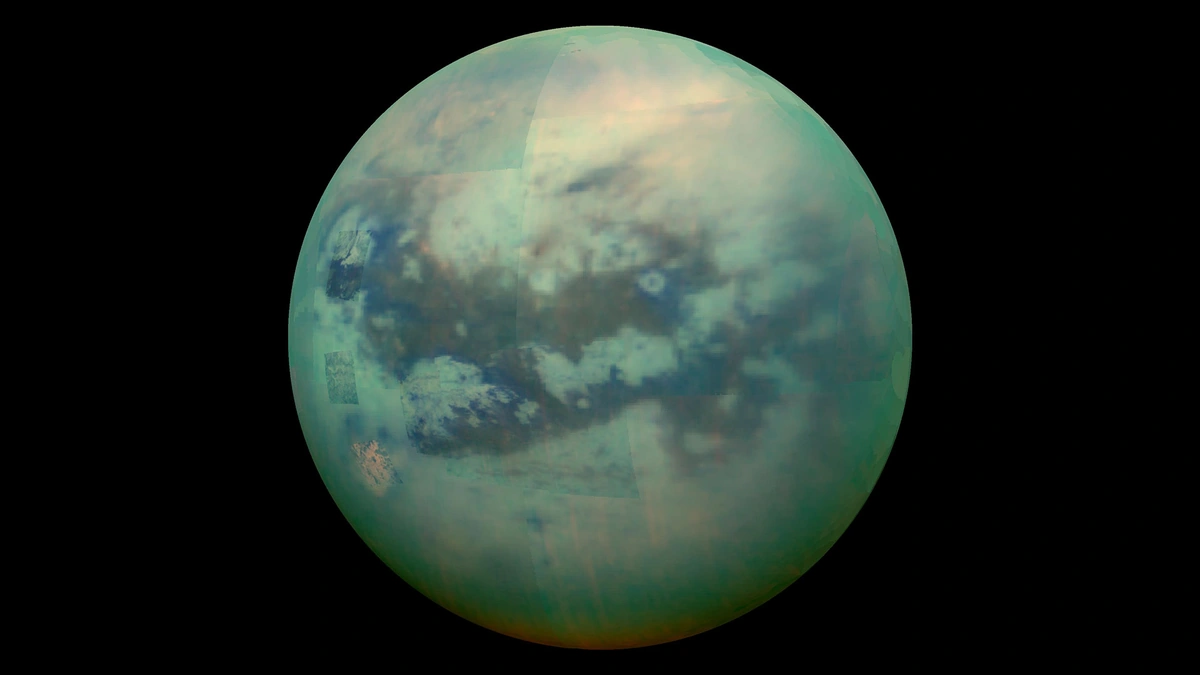
Here’s the thing about space: it’s ridiculously big. And within that vast expanse, we keep finding places that, against all odds, might support life. The latest head-turner? Saturn’s moon, Titan . NASA’s recent findings suggest Titan, a world with lakes of liquid methane and a thick, hazy atmosphere, could potentially harbor life – albeit a kind of life very different from what we’re used to here on Earth. But why does this matter, especially to us here in India?
Why Titan’s Potential Life Matters To You

Let’s be honest, the news cycle is relentless. So, why should you care about a moon orbiting Saturn, potentially harboring weird, lightweight life? Because it fundamentally changes our understanding of what’s possible. For generations, we’ve looked at Earth as the gold standard for life, needing liquid water, a certain atmospheric pressure, and a specific range of temperatures. Titan throws that all out the window. If life can exist in such an alien environment, imagine what else is out there! This discovery impacts everyone, but especially the younger generation in India. The youngsters are our future scientists, engineers, and explorers. A finding like this inspires innovation. It pushes us to think differently. Also, consider the international collaboration involved. NASA’s findings often involve researchers and data from around the globe, including India. This reinforces the importance of global partnerships in scientific advancement – something crucial for India’s continued growth in STEM fields. Beyond the immediate scientific implications, the search for life on Saturn’s moon pushes the boundaries of technology. These technologies often trickle down into everyday life. Think about the advancements in imaging, robotics, and materials science that come from space exploration – all things that can benefit India’s burgeoning tech sector. You can delve deeper into aspects of Titan ‘s chemistry for better understanding of this.
Titan | Not Your Average Habitable Zone
Okay, let’s dive deeper. What makes Titan so unique? Unlike Earth, with its water-based oceans and breathable atmosphere, Titan is a frigid world where the surface temperature hovers around -179 degrees Celsius (-290 degrees Fahrenheit). Instead of water, Titan’s lakes and seas are filled with liquid methane and ethane. The atmosphere is primarily nitrogen, like Earth’s, but it’s much denser and contains a thick haze of organic molecules. Now, here’s the fascinating part: scientists believe that life on Titan, if it exists, would have to be fundamentally different from life on Earth. It wouldn’t be based on water; it would likely be based on methane. It would need to be incredibly resilient to the extreme cold and the lack of sunlight. One leading theory suggests that Titanian life might involve cell membranes made of nitrogen compounds, rather than the phospholipids we see on Earth. These hypothetical organisms would also need to metabolize in a way that’s completely foreign to us. Instead of breathing oxygen and eating sugars, they might consume hydrogen and ethane, and exhale methane. It’s a wild concept, I know! But that’s what makes it so exciting!
The Evidence | What NASA Actually Found
So, what did NASA actually find that suggests the possibility of life on Titan? It’s not like they discovered little green aliens waving back at them! The evidence is more subtle, but still intriguing. Data from the Cassini-Huygens mission, which explored the Saturnian system for over a decade, revealed a few key anomalies. First, scientists observed a depletion of hydrogen near the surface of Titan. Hydrogen is a crucial ingredient for many chemical reactions, including those that could support life. The fact that it’s disappearing suggests that something – perhaps living organisms – is consuming it. Second, researchers found a lack of acetylene on Titan’s surface. Acetylene is an organic molecule that should be abundant, given the amount of sunlight and methane in Titan’s atmosphere. The fact that it’s missing suggests that something is breaking it down – again, possibly life. Third, there’s evidence of a compound called vinyl cyanide in Titan’s atmosphere. Vinyl cyanide is a key ingredient for forming cell membranes, and its presence suggests that Titan might have the building blocks for life. Now, it’s important to emphasize that these findings are not conclusive proof of life on Titan’s environment . There could be non-biological explanations for these anomalies. But they’re certainly compelling enough to warrant further investigation. You can know more about NASA’s work on this at NASA’s official website .
The Challenges of Finding Life on Titan
Let me rephrase that for clarity. Finding life on Titan won’t be a walk in the park – or a swim in a methane lake, for that matter. There are some serious challenges involved. First, Titan is incredibly far away. It takes years to travel to the Saturnian system, and any future mission to Titan would require advanced technology and a significant investment of resources. Second, the conditions on Titan are extreme. The temperature is frigid, the atmosphere is dense, and the surface is covered in liquid hydrocarbons. Any probe or lander sent to Titan would have to be incredibly robust to withstand these conditions. Third, it’s difficult to detect life from a distance. We can analyze Titan’s atmosphere and surface from afar, but it’s hard to get definitive proof of life without actually landing on the moon and examining its soil (or, rather, its hydrocarbon sludge) directly. A common mistake is to assume that technology used on Mars can be easily adapted for Titan. The environments are wildly different, requiring entirely new approaches to exploration. A crucial element will be developing instruments that can detect the specific biosignatures of methane-based life, which are likely very different from what we look for on Earth.
The Future | What’s Next for Titan Exploration?
So, what’s next for Titan exploration? NASA has already approved a mission called Dragonfly, which is scheduled to launch in 2027 and arrive at Titan in 2034. Dragonfly is a rotorcraft lander – essentially, a drone – that will hop around Titan, exploring different locations and analyzing its surface composition. It will be able to fly through Titan’s dense atmosphere, allowing it to access areas that would be impossible to reach with a traditional rover. Dragonfly is designed to search for evidence of past or present life on the moon Titan . It will carry a suite of instruments that can analyze the chemical composition of Titan’s soil, look for organic molecules, and even measure the moon’s seismic activity. It’s a hugely ambitious mission, and it has the potential to revolutionize our understanding of Titan. What fascinates me is that Dragonfly represents a new era of planetary exploration. It’s not just about sending probes to other worlds; it’s about sending flying probes that can explore those worlds in unprecedented detail. And who knows? Maybe Dragonfly will finally answer the question of whether or not Titan harbors life. Either way, the mission is sure to be a thrilling ride. In the meantime, Indian scientists and engineers can contribute to the analysis of existing data and participate in future collaborations related to Titan. The expertise in data analysis and software development in India is a valuable asset that can be leveraged in these international efforts. Nebula can lead to new possibilities.
FAQ About Life on Titan
Is there definitive proof of life on Titan?
No, there is currently no definitive proof of life on Titan. The data collected so far only suggests the possibility of life.
What would life on Titan be like?
Life on Titan, if it exists, would likely be very different from life on Earth. It would probably be based on methane rather than water.
When will we know for sure if there is life on Titan?
The Dragonfly mission, launching in 2027, will provide more data to help us determine if life exists on Titan.
Could humans ever live on Titan?
While Titan is not habitable for humans in its current state, some scientists speculate that it could be terraformed in the distant future.
What makes Titan unique?
Titan is unique because it’s the only moon in our solar system with a dense atmosphere and liquid on its surface. The presence of methane lakes and seas makes it a fascinating place to search for life.
How can I stay updated on the latest Titan discoveries?
Follow NASA’s official website and social media channels for the latest news and updates on Titan exploration.
About the Author